Why SaaS Platforms Fall Short? Hidden Costs, Delays, Bugs, & Security Risks Hurting Your Agency

Three years into running a successful digital agency, a tech lead in Austin watched a SaaS platform outage wipe out an entire client campaign launch on a Friday afternoon, 48 hours before go-live. Support responded Monday morning. The client did not wait that long.
Unfortunately, agency lost the contract. The SaaS vendor issued a routine apology and a one-month credit.
This is not an isolated horror story. It is the operational reality facing thousands of agencies that built their businesses on software they do not own, cannot control, and cannot fix when it breaks.
This article breaks down the most damaging common SaaS issues for agencies, from ballooning costs and unreliable performance to data exposure and strategic lock-in, and shows why forward-thinking agencies are making the shift to custom software before the next outage forces their hand.
Why SaaS Issues Occur & Why SaaS Platforms Fail Agencies?
Because SaaS platforms present complicated, unanticipated difficulties that exceed their early ease, and often fail to live up to their claims of streamlining agency operations. These failures are mostly caused by “SaaS sprawl,” where uncontrolled, fragmented app adoption produces an unmanageable, unsecure environment that depletes budgets and productivity.
These failures include hidden costs, deployment delays, technical flaws, and security vulnerabilities.
Here is a breakdown of why SaaS scalability problems often fail agencies:
#1. Hidden Costs That Destroy ROI
While SaaS offers a lower barrier to entry, the total cost of ownership (TCO) often explodes due to overlooked expenses:
SaaS Sprawl and Duplicate Apps - When departments purchase tools without central IT management, they end up paying for several identical tools.
Underutilized Licenses (Shelfware) - Businesses pay for licenses that are either completely or partially unused, and 66% of applications are wasted.
Third-Party API & Storage Fees - Data storage, API calls, and premium feature upgrades are rarely included in the base price and increase as the business grows.
Auto-Renewals - Due to a lack of visibility, superfluous tools are automatically renewed, costing 20–30% more than necessary.
#2. Implementation Delays And Operational Disruptions
SaaS projects face high failure rates, with 75% of companies experiencing implementation delays, often stemming from:
Complex Integrations: Integration issues are frequently caused by poor communication between IT teams and SaaS providers, especially when integrating contemporary SaaS with legacy systems.
Inadequate Change Management: When internal process changes and user training are underestimated, resistance is created, which slows acceptance and reduces productivity.
Workflow bottlenecks: Ineffective communication and decision-making result from data fragmentation caused by various departments using different tools.
#3. Bugs, Stability, And Technical Limitations
No software is bug-free, but SaaS integration failures can severely impact agency workflows when technical issues arise:
Post-Launch Stabilization: New platforms sometimes require considerable bug repairs, stability maintenance, and customization throughout the first 60 to 90 days, which could cost 15 to 20 percent of the initial budget.
Performance bottlenecks: Ineffective architecture can result in outages or slow response times, which directly affect the provision of customer service.
Lack of Customization: SaaS systems occasionally offer one-size-fits-all solutions that can’t meet the particular needs of agencies.
#4. Security Risks and Compliance Failures
When businesses utilize tools they are unable to safeguard, they run the danger of falling victim to the “SaaS Visibility Trap”:
Shadow IT: Eighty percent of workers use SaaS apps that have not been authorized by IT, creating major data threats.
API Security Gaps: An enormous, inadequately secured surface for data breaches is created by the growing use of APIs to link apps.
Privilege Creep and Inactive Admins: Over-privileged or inactive user accounts that give hackers back-door access account for 41% of security issues.
Insider Threats and Data Leaks: Loss of intellectual property may result from unapproved tools being used to share credentials or data.
To avoid these pitfalls, agencies must move beyond simply adopting tools and instead, implement robust SaaS management, proper onboarding, and centralized oversight of security and spend.
Software Bugs In SaaS Tools
SaaS Cost Overruns: The Budget Leak Nobody Tracks
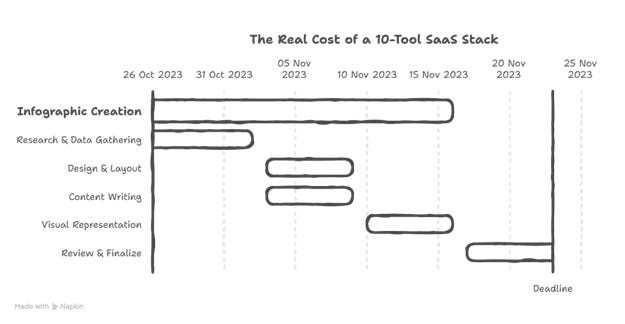
When an agency signs up for a SaaS platform, the entry price is rarely the price they end up paying.
SaaS cost overruns follow a predictable pattern. The features an agency actually needs, advanced reporting, API integrations, white-labeling, higher usage limits, and priority support are locked behind premium tiers. Per-seat pricing inflates as headcount grows. Add-on modules, third-party connectors, and annual contract escalations stack on top of each other until the monthly SaaS bill looks nothing like the original budget line.
According to a 2023 Productiv report, companies waste an average of 44% of their SaaS spend on unused or underutilized licenses. For a mid-sized agency running 10 to 15 tools simultaneously, that figure translates to thousands of dollars in monthly waste — money that funds a vendor’s growth, not the agency’s.
The compounding problem is that no single line item looks alarming. Each tool seems justified in isolation. It is the aggregate that quietly hollows out the operating budget.
When agencies evaluate custom software vs SaaS over a three-year horizon, the economics consistently favor a purpose-built solution. The upfront development investment is offset by the elimination of redundant subscriptions, unused features, and per-seat fees that grow with every new hire.
SaaS Platform Limitations and the Vendor Roadmap Trap
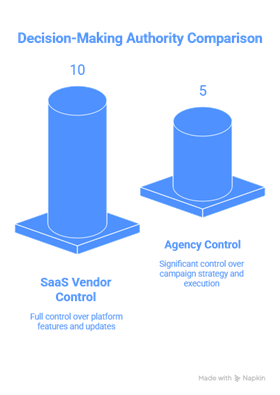
Every agency that has submitted a feature request to a SaaS vendor knows the response: “Thanks for the feedback, we’ll pass this to our product team.”
That response is where agency timelines go to wait indefinitely.
SaaS platform limitations are not accidental. They are architectural. Off-the-shelf software is engineered to serve the broadest possible user base, which means agency-specific needs custom client portals, bespoke reporting logic, industry-specific automation are perpetually deprioritized behind features that serve the median customer.
Updates ship on the vendor’s schedule. A UI overhaul that seems minor from the vendor’s perspective can dismantle months of internal process documentation built around the previous interface. And when those updates introduce breaking changes, the agency absorbs the disruption while the vendor moves on to the next release cycle.
SaaS downtime impact compounds this further. Industry-standard SLA agreements routinely permit 99.9% uptime language that sounds reassuring until the math reveals it allows for over eight hours of annual downtime. Those hours do not schedule themselves around low-traffic periods. They arrive during campaign launches, client presentations, and deadline-critical delivery windows.
Data Security Risks SaaS Creates — and Why Agencies Are Exposed
Of all the common SaaS issues for agencies, data security carries the highest potential cost financially, legally, and reputational.
Data security risks SaaS environments introduce are inherent to how these platforms are built. Multi-tenant infrastructure houses data from thousands of organizations on shared systems. Reputable vendors implement isolation protocols, but the aggregate attack surface is significantly larger than any purpose-built, dedicated environment. A vulnerability in one tenant’s configuration can have cascading effects across the shared infrastructure.
IBM’s 2024 Cost of a Data Breach Report placed the global average breach cost at $4.88 million, the highest figure ever recorded. Breaches involving third-party software vendors were among the most expensive to remediate, with longer detection timelines and broader data exposure.
For agencies operating under GDPR, HIPAA, or SOC 2 frameworks, the compliance dimension adds another layer of exposure. Vendor terms of service frequently include data-sharing clauses that conflict directly with client confidentiality agreements. Audit trails provided by SaaS platforms often lack the granularity that regulatory frameworks require for defensible reporting.
Continuous security testing is the operational standard Co-Ventech applies to every custom build. Security architecture is not retrofitted after a breach, but embedded from the first line of code. Access control design, encrypted data pipelines, and compliance-ready audit logging are foundational components, not optional upgrades.
SaaS Integration Failures: When the Stack Stops Talking to Itself?
Most agencies do not run one SaaS platform. They run an ecosystem of interconnected tools — each one dependent on the others functioning correctly, sharing data cleanly, and updating without breaking the connections between them.
SaaS integration failures are among the most disruptive and least discussed operational risks in agency software environments. When a platform updates its API without sufficient notice, integrations built on that API break. When two tools interpret data fields differently, records corrupt silently across systems. When a Zapier-dependent workflow fails at 2 a.m., no one finds out until a client asks why their onboarding sequence stopped.
These failures do not appear in SaaS marketing materials. They appear in post-mortems.
SaaS scalability problems accelerate this dynamic. As agencies grow and add complexity — more clients, more data sources, more reporting requirements — the integration architecture holding the stack together becomes increasingly fragile. Each new tool is another potential point of failure.
Custom software eliminates the integration patchwork entirely. When the system is built as a unified architecture from the ground up, data flows between components by design — not through third-party connectors held together by workarounds.
SaaS Vendor Lock-In: The Strategic Trap That Closes Slowly
SaaS vendor lock-in does not happen loudly, but silently develop over months and years as an agency builds workflows, automations, client-facing portals, and reporting systems around a specific platform’s logic.
By the time the vendor raises prices, gets acquired by a larger company, or discontinues a mission-critical feature, the switching cost has grown into a serious operational project. Data portability is rarely seamless. Workflows built on platform-specific configurations do not transfer. Team retraining consumes weeks of productivity at exactly the moment the agency can least afford disruption.
The exit cost is almost never factored into the original SaaS adoption decision. Vendors structure their platforms with full knowledge of this dynamic.
Custom software eliminates this vulnerability entirely. The codebase belongs to the agency. There is no vendor to renegotiate terms with, no acquisition that rewrites the service agreement, and no product sunset that dismantles operational infrastructure built over years.
SaaS Scalability Problems: The Ceiling Every Growing Agency Hits
SaaS tools are built for the average user at an average scale. For agencies on an upward trajectory, that design philosophy eventually becomes a hard constraint.
SaaS scalability problems surface in predictable ways: the reporting module cannot handle the data volume of a growing client base; the workflow builder lacks the conditional logic a complex service offering requires; the white-labeling options are too limited to support a client-facing portal that reflects the agency’s brand.
Upgrading plans addresses pricing tiers. It does not address architectural ceilings.
Stop Renting Infrastructure You Cannot Control
The common SaaS issues for agencies covered in this article are not edge cases. They are the predictable, documented consequences of building an agency’s operational foundation on software owned, maintained, and ultimately controlled by someone else.
SaaS cost overruns drain margins quietly. SaaS platform limitations cap growth at the vendor’s ceiling. Software bugs in SaaS tools turn into client-facing failures. Data security risks SaaS environments create expose agencies to breaches and compliance violations. SaaS vendor lock-in converts operational dependency into strategic vulnerability.
The agencies positioned to win the next phase of growth are the ones investing in infrastructure they own software built specifically for how they work, secured by design, and scalable without architectural constraints.
Co-Ventech is the partner agencies turn to when they are ready to make that transition.
👉 Ready to move beyond SaaS limitations?
Explore Co-Ventech’s custom software development and QA engineering solutions.
Visit co-ventech.com to start the conversation.
----------------------------------------------------------------------------------
Co-Ventech | Custom Software Development · QA Engineering · Security-Aware Architecture